
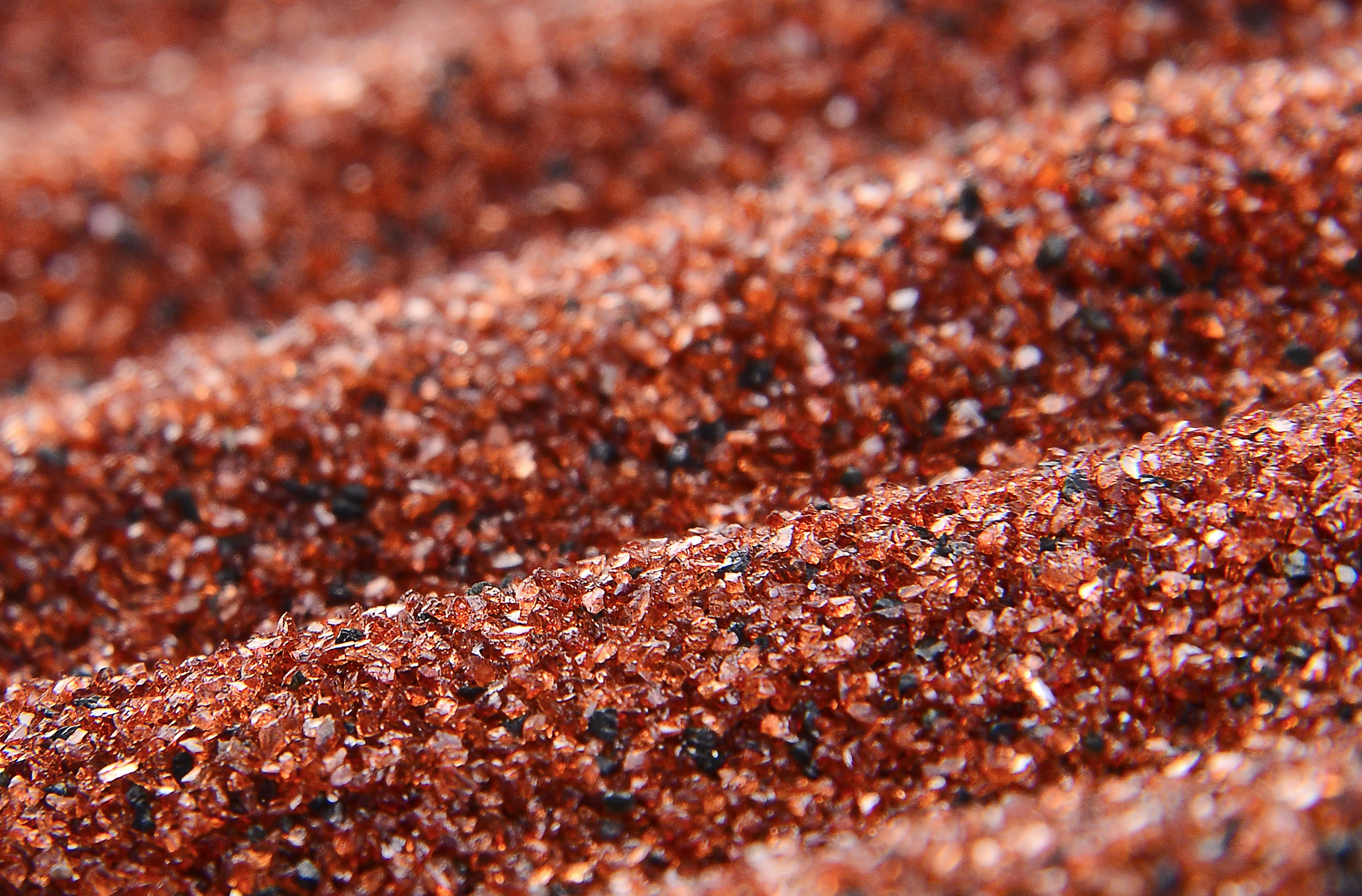
Garnet Abrasive
Mesh Size Guide
Selecting the wrong mesh size costs time, abrasive, and surface quality. This technical guide covers every garnet mesh grade for sandblasting and waterjet cutting — with particle size ranges, blast rates, surface profiles, and application recommendations.
What Does
Mesh Size Mean?
Mesh size refers to the number of wires per linear inch in the sieve screen used to classify abrasive particles. A higher mesh number means smaller particles. For garnet abrasive, mesh size directly determines surface profile depth, blast rate, and finish quality — making it the single most important specification when selecting a grade.
Coarser Mesh = Faster, Deeper
Low mesh numbers (16, 20, 30) produce large particles that cut faster and create a deeper surface profile — essential for heavy steel plate, heavy mill scale, or thick coating removal.
Finer Mesh = Smoother Finish
High mesh numbers (80, 120) produce small particles that cut slower but leave a finer surface profile — required for thin-film coatings, aerospace parts, and precision surface preparation.
Blended Grades for Versatility
Dual-fraction grades (e.g. 16/30 or 30/60) blend two mesh sizes for a broader particle range — balancing blast rate and surface finish for general-purpose industrial blasting.
Garnet Mesh Sizes
for Sandblasting
OneGarnet™ and JadeCut® sandblasting abrasive is available in the grades below. All grades achieve Sa3 bare-metal cleanliness. Mesh selection depends on required surface profile depth, coating system, and substrate.
| Mesh Grade | Particle Range | Surface Profile | Blast Rate | Typical Use | OneGarnet™ | JadeCut® |
|---|---|---|---|---|---|---|
| 8/16 | 1.19–2.36 mm | Rz 100–150 µm | Very Fast | Extremely heavy mill scale, heavily pitted surfaces, old coating removal (multi-layer) | ✓ | — |
| 16/30 | 0.60–1.19 mm | Rz 70–100 µm | Fast | Heavy steel plate, heavy mill scale, offshore structure surface preparation, Sa3 | ✓ | ✓ |
| 30/60 | 0.25–0.60 mm | Rz 40–70 µm | Fast–Medium | General industrial: structural steel, shipbuilding, pipeline, marine coating prep | ✓ | ✓ |
| 80 | 0.18 mm | Rz 25–45 µm | Medium | Thin-film coatings, aluminium, stainless steel, shallow anchor profile requirements | ✓ | ✓ |
* Surface profile values measured to ISO 8503 using replica tape. Actual results depend on nozzle pressure, standoff distance, and angle of impact. Contact us for application-specific mesh recommendations.
Garnet Mesh Sizes
for Waterjet Cutting
Waterjet cutting uses finer garnet grades than blasting. Mesh selection trades cut speed against surface finish and operating cost. OneGarnet™ Waterjet Abrasive is produced with zero oversized particles and no dust — preventing nozzle blockage and maintaining consistent flow rate.
| Mesh Grade | Particle Range | Cut Speed | Surface Finish | Typical Application |
|---|---|---|---|---|
| 20/40 | 0.43–0.85 mm | Very Fast | Coarse (Ra 4–6) | Thick steel plate, rough profile cutting, aggressive stock removal |
| 30/60 | 0.25–0.60 mm | Fast | Medium-Coarse (Ra 2.5–4) | General waterjet: steel, aluminium, thick composites, stone |
| 80 | 0.18 mm | Medium | Smooth (Ra 1–2) | Standard waterjet cutting: thin plate, glass, ceramics, tighter tolerances |
| 120 | 0.13 mm | Slow–Medium | Fine (Ra 0.5–1) | Precision aerospace parts, fine composites, polished finish requirements |
* Consumption and finish values are indicative and depend on operating pressure (typically 3,800–6,200 bar), orifice size, and nozzle configuration. Contact us for OEM-specific mesh recommendations.
How to Choose the
Right Garnet Mesh Size
Mesh selection depends on three variables: the substrate and its condition, the coating system being applied, and the required surface profile depth. Use this decision framework to select the right grade.
Heavy Steel — Sa3 Fast Prep
Recommend: 16/30 meshNew steel plate with heavy mill scale or heavily pitted surfaces for offshore coating. Select 16/30 mesh for maximum blast rate and deep profile (Rz 70–100 µm). Suitable for high-build epoxy and fusion-bonded epoxy (FBE) systems.
Structural Steel — General Prep
Recommend: 30/60 meshStructural steel bridges, storage tanks, and marine infrastructure requiring Sa2½–Sa3 for standard epoxy or polyurethane coating systems. 30/60 mesh delivers the broadest production rate with consistent Rz 40–70 µm profile.
Thin Plate or Light Aluminium
Recommend: 80 meshThin sheet metal, aluminium, or surfaces where a shallow anchor profile is required for thin-film coatings. 80 mesh prevents over-profiling that would cause thin-film systems to bridge the peaks and fail adhesion.
General Waterjet Cutting
Recommend: 80 meshFor general waterjet cutting of steel, aluminium, stone, composites, and glass up to 100 mm thickness. 80 mesh (0.18 mm) is the universal standard across Flow, OMAX, Bystronic, and most major waterjet systems.
Precision Aerospace / Fine Parts
Recommend: 120 meshAerospace components, thin-wall parts, and precision composites requiring the finest kerf and minimum mechanical stress to the cut edge. 120 mesh garnet produces Ra 0.5–1 finish suitable for aerospace and medical-grade tolerances.
High-Volume Structural Blasting
Recommend: JadeCut® 30/60High-throughput structural and marine blasting where Sa3 is required but premium garnet hardness is not a specification constraint. JadeCut® 30/60 mesh delivers Sa2½–Sa3 at 30–50% lower cost than OneGarnet™ almandine grade.
Garnet Mesh Size
Common Questions
What mesh size garnet is best for industrial sandblasting?
For most industrial sandblasting (Sa2½–Sa3), 16/30 or 30/60 mesh are the most widely specified. 16/30 is preferred for heavy mill scale and aggressive stock removal. 30/60 is the general-purpose standard for structural steel, shipbuilding, and pipeline blasting. Use 80 mesh when a shallower profile is required for thin-film coatings.
What garnet mesh size is used for waterjet cutting?
80 mesh (approximately 0.18 mm) is the standard for general waterjet cutting, balancing cut speed and surface finish. 30/60 is used for fast cutting of thick plate; 120 mesh for precision aerospace and fine composites. Only use grades specifically produced and certified for waterjet — blasting grades cause nozzle damage.
What is the difference between 30 mesh and 80 mesh garnet?
30 mesh particles (~0.60–0.85 mm) cut faster and produce a deeper profile (Rz 70–100 µm). 80 mesh particles (~0.18 mm) cut slower but produce a finer profile (Rz 25–45 µm for blasting; fine kerf for waterjet). Coarser mesh = faster rate + deeper profile; finer mesh = slower rate + smoother finish.
What surface profile does 30/60 mesh garnet produce?
At standard blasting conditions, 30/60 mesh garnet typically produces Rz 40–70 µm (approximately 1.5–2.8 mils). This is suitable for the majority of marine, offshore, and structural coating systems. Actual values depend on nozzle pressure, standoff distance, and impact angle.
Can I use blasting garnet for waterjet cutting?
No. Waterjet garnet requires zero oversized particles and zero dust to protect mixing tubes and nozzles. Standard blasting grades have wider particle distributions that will block or damage waterjet systems. Always use a grade specifically produced for waterjet applications.
Garnet Sandblasting Abrasive
Full technical specifications for OneGarnet™ and JadeCut® blasting grades. Sa3 cleanliness, Class 1 dust, ISO certified.
View Sandblasting ProductsWaterjet Garnet Abrasive
Zero oversized particles, superior cut quality, minimal consumption. Compatible with all major waterjet machine brands.
View Waterjet ProductsBulk Supply for Europe
Mine-direct pricing. CIF to Hamburg, Rotterdam, Antwerp, Le Havre. 25 kg bags and 1,000 kg big bags available.
European Supply Options Need a Mesh Size
Recommendation?
Our technical team advises on mesh selection based on your substrate, coating specification, and production requirements. Bulk supply to Germany and all European markets.